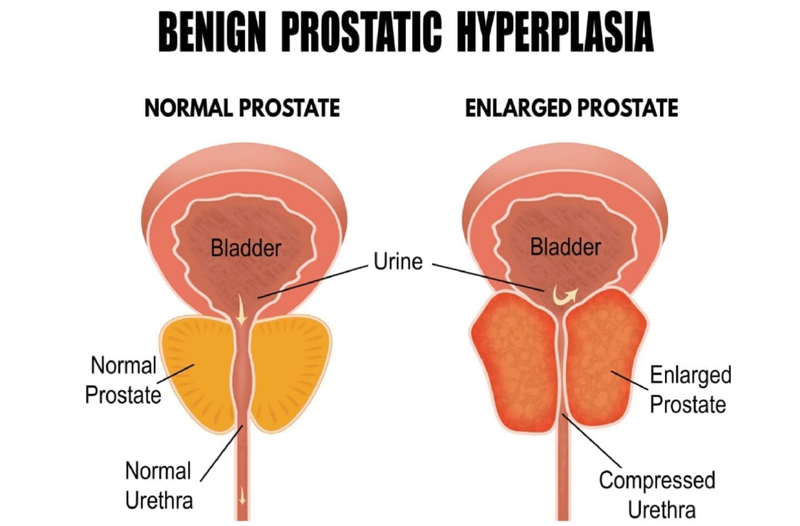
Why is urination more difficult?
17 March 2026
Beyond the Waiting Game: Why Modern Men Are Choosing Minimally Invasive Treatments for an Enlarged Prostate (BPH)
15 September 2026TURP Isn't Your Only Option Anymore: What HoLEP and Rezum Mean for BPH Treatment Today
If you've been told you might need surgery for an enlarged prostate, chances are the first procedure you heard about was TURP — transurethral resection of the prostate. It's the operation most men's fathers and grandfathers had, and for decades it was the only real surgical option on the table.
The good news is that's no longer true. Urology has moved on a great deal in the last fifteen years, and two newer treatments — HoLEP (Holmium Laser Enucleation of the Prostate) and Rezum (water vapor thermal therapy) — now give men real alternatives that didn't exist when TURP became the standard. Understanding how they differ from TURP, and from each other, can make the conversation with your urologist a lot less intimidating.
What TURP Actually Involves
TURP works by inserting an instrument through the urethra and shaving away the inner part of the enlarged prostate using an electrical loop, opening up the channel urine flows through. It's been studied for decades, which is exactly why it became the benchmark every newer procedure gets compared against.
That long track record comes with some well-documented trade-offs. Most men spend one to three days in hospital with a catheter in place, and there's a real risk of bleeding significant enough to need a transfusion in roughly 5.7% of patients. Furthermore, not all of the obstructing prostate can be removed with a recurrence rate of 10% at 10 years. The change men notice most often afterward is retrograde ejaculation — semen entering the bladder instead of exiting normally during climax — which affects somewhere between 70% and 96% of men who undergo the procedure. Orgasm sensation is usually unaffected, but it does mean natural conception is no longer possible afterward.
None of this makes TURP a bad procedure — it's been refined for over 80 years and remains genuinely effective at relieving blockage. But it does mean it's worth knowing what else is on the table before assuming it's your only path forward.
HoLEP: The Laser Option That Handles Any Size Prostate
HoLEP uses a holmium laser to carve out the entire obstructive zone of the prostate, much deeper than what TURP removes and with far more precision and far less bleeding, because the laser seals blood vessels as it cuts. The tissue is then broken up and sucked out through the bladder — a process called morcellation.
Research increasingly describes HoLEP as a size-independent gold standard, meaning it works just as well on a very large prostate as a small one — offering excellent long-term outcomes and a stronger safety profile than TURP, particularly around bleeding. That matters a lot for two groups of men in particular: those with larger glands who might otherwise have needed open surgery, and those on blood-thinning medication, since the laser's haemostatic effect makes bleeding complications considerably less likely.
The practical benefits show up in recovery, too. Compared with TURP, HoLEP patients in one study went home with a catheter in for roughly 22 hours versus 50 hours, and spent about one night in hospital versus three with TURP.
Worth knowing: the standard HoLEP doesn't spare men from retrograde ejaculation. Because it removes tissue from the same area near the bladder neck, rates are similar to TURP — studies report it occurring in 70% to 96% of cases. A newer modification of the HOLEP procedure however, leaving tissue around the sperm ducts, have proven to preserve ejaculation in many new studies.
Its real strength is treating any size prostate thoroughly and durably with less blood loss and a faster discharge.
Rezum: The In-Office Option Built Around Preserving Function
Rezum takes a completely different approach. Instead of cutting or removing tissue, it delivers small bursts of sterile water vapor directly into the enlarged areas of the prostate. The steam's thermal energy causes those cells to die off, and the body gradually reabsorbs the tissue over the following weeks, shrinking the obstruction from the inside.
Because there's no resection involved, Rezum can typically be done in a single office visit under local anaesthesia or light sedation, without the need for a hospital stay or general anaesthetic. Five-year follow-up data from the original pivotal trial found fewer than 5% of men needed a further procedure or surgery, while around 10% needed to restart BPH medication within that period.
Its standout feature is sexual function. In a five-year analysis of men who were sexually active before treatment, erectile and ejaculatory function were preserved, with no patient shifting into a worse functional category over the follow-up period. That's a meaningfully different conversation than the one you'd have before TURP or HoLEP.
Rezum isn't right for every anatomy, though. Current evidence and guidance support its use mainly for prostates in the 30–80 cc range, and because the tissue shrinks gradually rather than being removed immediately, symptom relief tends to build over several weeks rather than being instant.
So Is TURP Ever Still the Right Call?
Sometimes, yes. Guidelines still list it as a recommended option, and there are situations — certain anatomy, access to specific equipment or training, or a patient's individual priorities — where it remains a reasonable choice. The point isn't that TURP is obsolete; it's that for most men today, it shouldn't be presented as the only option, when HoLEP and Rezum each solve different problems TURP doesn't.
|
|
TURP |
HoLEP |
Rezum |
|
Setting |
Hospital |
Hospital (often overnight or day case) |
Office or ambulatory centre |
|
Typical catheter time |
1–7 days |
~1 day |
Several days, at home |
|
Bleeding risk |
Moderate (transfusion in some cases) |
Low |
Minimal |
|
Best suited to |
Less than 80cc |
Any size, including very large glands |
30–80 cc prostates |
|
Retrograde ejaculation |
Common |
Common (less common with newer techniques) |
Rare |
|
Time to full symptom relief |
Fast |
Very Fast |
Several weeks |
Talking to Your Urologist
The right procedure depends on your prostate size, whether you're on blood thinners, how soon you need relief, and — often the deciding factor for many men — whether preserving ejaculatory function matters to you. None of these treatments is universally "better"; they're suited to different priorities and anatomy.
At ProstaCare+, Dr. Amit Kalpee works through these trade-offs individually with every patient, so the procedure you choose actually matches what matters most to you — not just whichever option you happened to hear about first. If you've been told TURP is your only path forward, it's worth a conversation to find out whether that's still true in your case.
Sources
- American Urological Association. Surgical Management of Lower Urinary Tract Symptoms Attributed to Benign Prostatic Hyperplasia: AUA Guideline Amendment 2023. J Urol.
- Urology Times. Updated AUA guidelines on BPH: What urologists need to know.
- Increased risk of bleeding during and after HoLEP in patients with prostate cancer: A multicentre comparative cohort study.
- HoLEP Versus TURP in Elderly Patients: Insights Into Recovery, Complications, and Risk Factors.
- Gild P, et al. Retrograde ejaculation after holmium laser enucleation of the prostate (HoLEP). 2020.
- Cleveland Clinic. Rezūm Water Vapor Therapy: Procedure & Results.
- Boston Scientific / McVary KT, et al. Physician's Perspective: Rezūm Water Vapor Therapy.
- Preservation of Sexual Function 5 Years After Water Vapor Thermal Therapy for Benign Prostatic Hyperplasia.
- A Comparative Study of TURP Versus TUIP in Small-Sized Prostate Glands.